

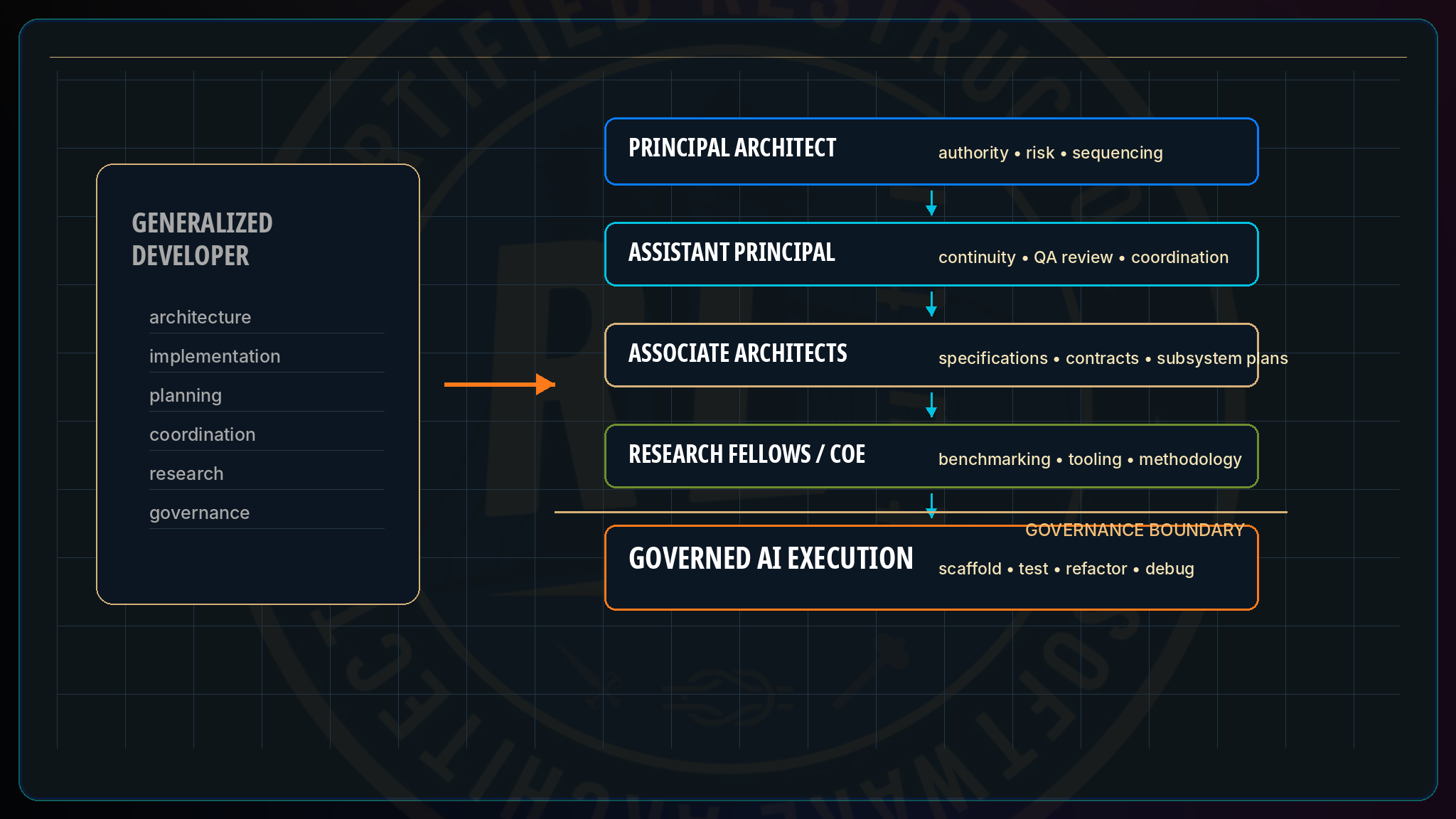
For decades the software industry collapsed architecture, implementation, coordination, planning, governance, and research into one generalized "developer" role — then acted surprised when systems became impossible to coordinate.
Mature industries solved this long ago. Architecture firms separate principals, project architects, coordinators, and contractors. Law firms separate partners, associates, and clerks. Engineering firms separate licensed engineers, analysts, and technicians. Software organizations mostly did not. The same people were expected to design systems, implement features, coordinate dependencies, estimate timelines, attend meetings, maintain operational stability, and somehow still produce high-quality architecture under constant interruption.
This problem predates AI by close to a decade. Backend engineers functioned as the de facto architects of most software organizations, and frontend developers were looked down on — toxic and often unfair, but the underlying instinct that backend work carried more architectural weight was not wrong. Over the past ten years the market flooded with engineers labeled “fullstack,” the majority of whom leaned frontend in practice. The title created vagueness about who was actually any good at architecture. The result was an organizational layer that all looked the same on paper and, in practice, very uneven on architectural judgment.
Furthermore, gatekeeping access to powerful infrastructure is not a novel concept in software organizations. For most of the 2010s, backend engineers gated frontend developers out of AWS, production databases, deployment pipelines, and infrastructure-as-code repositories — not out of elitism, but because the blast radius of a misconfigured S3 bucket, a wrong-region RDS instance, or an unbounded Lambda was real and the cost of misuse compounded fast. The pattern was so widely accepted that no one called it gatekeeping; it was called “ops discipline” or “production access controls.” The fullstack movement and the rise of platform engineering eventually softened those boundaries, but only by replacing direct access with governed self-service: paved roads, internal developer platforms, infrastructure modules, and approval workflows that preserved the safety guarantees while widening the user base. The boundary did not disappear; it was abstracted. Read against that history, the Restruct ™ restriction of AI orchestration to the Principal Architect layer is a continuation of a pattern the industry already accepted, not a departure from it. AI execution against production code has a blast radius at least as large as raw AWS access, compounds faster, and produces context fragmentation that infrastructure access never did. Gating it isn't a stretch — it's the same instinct, applied to the new high-leverage capability.
This is also part of why scrum eventually stopped working as well as its earliest practitioners remember it working. There was a time when a sprint planning room had a meaningful concentration of backend engineers — effectively architects — and consensus-based planning produced decent architectural decisions because the people in the room knew what they were doing at the system level. As the fullstack flood inverted that ratio, the architectural quality of consensus-based sprint planning fell year over year. Most organizations never noticed the cause; they only felt the symptom, which was that planning meetings produced increasingly diluted decisions. The architects-versus-labor distinction is not an idea AI made necessary. AI just exposed and exacerbated something that had been quietly degrading the industry for a long time.
Agentic coding is already familiar territory for existing architects. The traditional architect spends roughly 80% of their time asking themselves questions before typing any code anyway. Agentic coding does not introduce a new mental mode; it externalizes one architects already had — rubber ducking made tangible, or talking to a peer agent instead of to oneself. The mental discipline does not change. Only the medium does.
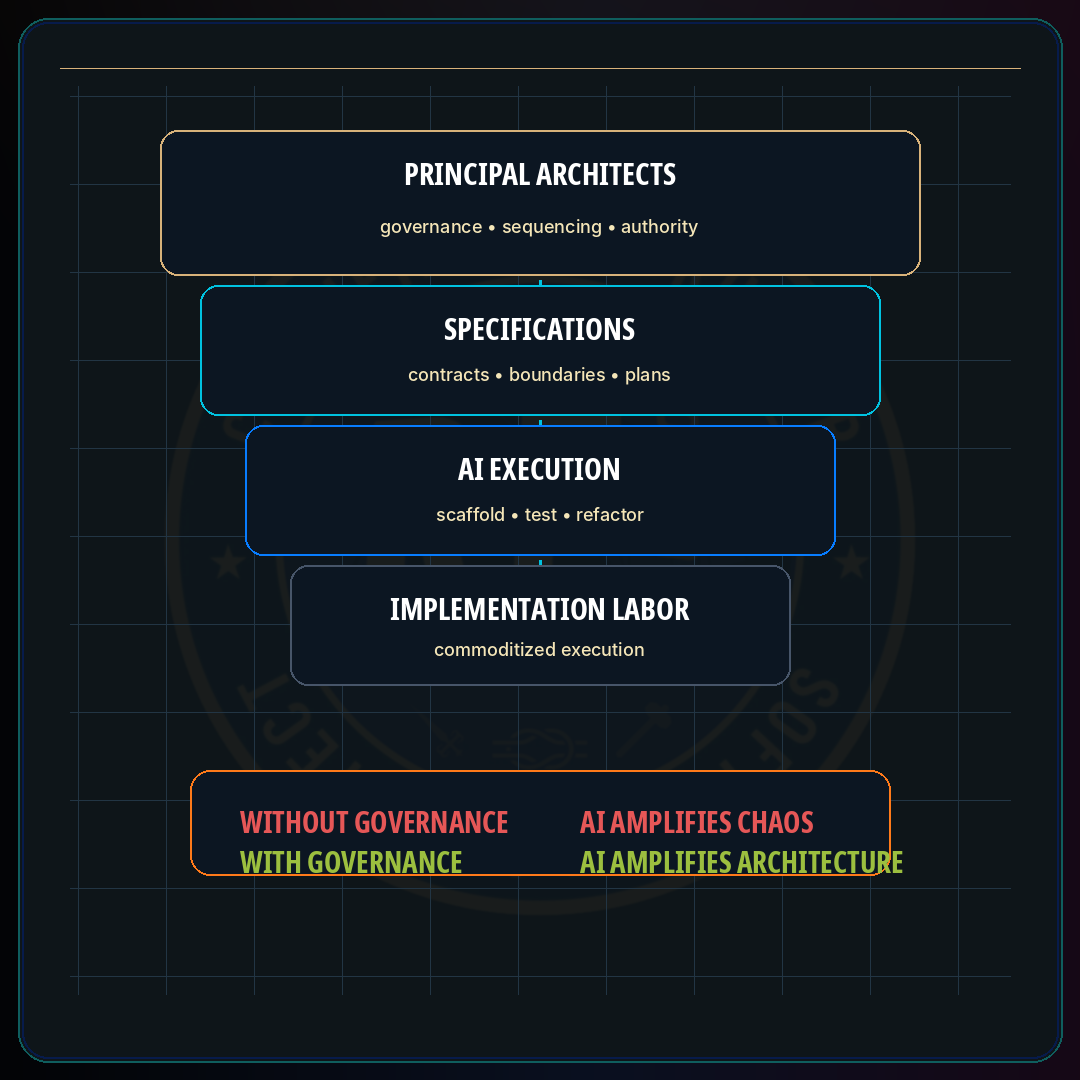
Restruct ™ reintroduces professional hierarchy. Principal Architects govern. Associate Architects coordinate and plan. Research Fellows support through tooling and methodology. AI handles repetitive implementation under governed oversight. Without governance, AI amplifies chaos. With governance, AI amplifies architecture.
This is also where Team Topologies’ emphasis on cognitive load matters more than ever. When AI compresses execution, the load on a team does not disappear — it shifts from writing the system to governing it: subsystem boundaries, sequencing decisions, contract definitions, AI orchestration discipline. That load is heavier and less divisible than implementation work, which is exactly why concentrating it in a Principal Architect layer rather than spreading it thinly across generalists matters in an AI-native organization.
One implication worth naming up front: the methodology skews heavily toward individual-contributor work rather than traditional engineering management. The coordination, sequencing, and prioritization that an engineering manager would normally hold are absorbed into Principal Architect duties, where they sit closer to the technical decisions they affect. This is not a claim that engineering management is unnecessary — it is a claim that the function consolidates upward into governed architecture rather than running as a parallel ladder. Organizations migrating to Restruct ™ should expect the EM role to either evolve into Principal Architect work for technically strong EMs, or shift toward operational program management at larger scale where cross-Architecture-Group coordination becomes a real job.
© 2024–2026 Vitruvian Technology, Corp. All rights reserved. The Restruct Handbook and its contents are the copyrighted work of Vitruvian Technology, Corp. The handbook may be freely shared and distributed in its complete, unmodified form for educational and informational purposes, provided that all copyright and trademark notices are retained and Vitruvian Technology, Corp. (Vestive) is credited as the source. Excerpts and brief quotations may be used in articles, reviews, presentations, and other commentary with appropriate attribution. Modification, repackaging, or commercial redistribution requires prior written permission. Restruct™ and Certified Restructor™ are trademarks of Vitruvian Technology, Corp. Vestive® is a registered trademark of Vitruvian Technology, Corp. The Restruct™ methodology, the Certified Restructor™ program, and associated trademarks remain the exclusive property of Vitruvian Technology, Corp.