

Modern software UX should emerge from operational systems and data structures rather than disconnected visual mockups. Especially in B2B software, interfaces succeed or fail based on workflow clarity, operational semantics, permissions, and business logic — not handcrafted aesthetics.
Many organizations historically separated product design and engineering into disconnected phases: designers produced abstract visual prototypes divorced from real architecture, then engineering spent months translating mockups into governed systems. Restruct ™ promotes schema-first UX, where interfaces directly mirror API contracts, data models, and operational workflows. Prototypes should operate as functional architectural systems from the start, not static visual concepts. This is the UX-layer expression of the same governed-foundations principle that Chapter 7 makes at the system level: SDK-first development builds reusable governed foundations; schema-first UX surfaces them.
Off-the-shelf UI systems are commoditizing aesthetic implementation, and AI handles branding semantics, visual refinement, and styling consistency increasingly well. The harder problem is operational clarity. The future of UX is operationally-driven interfaces built around governed data systems and execution semantics.
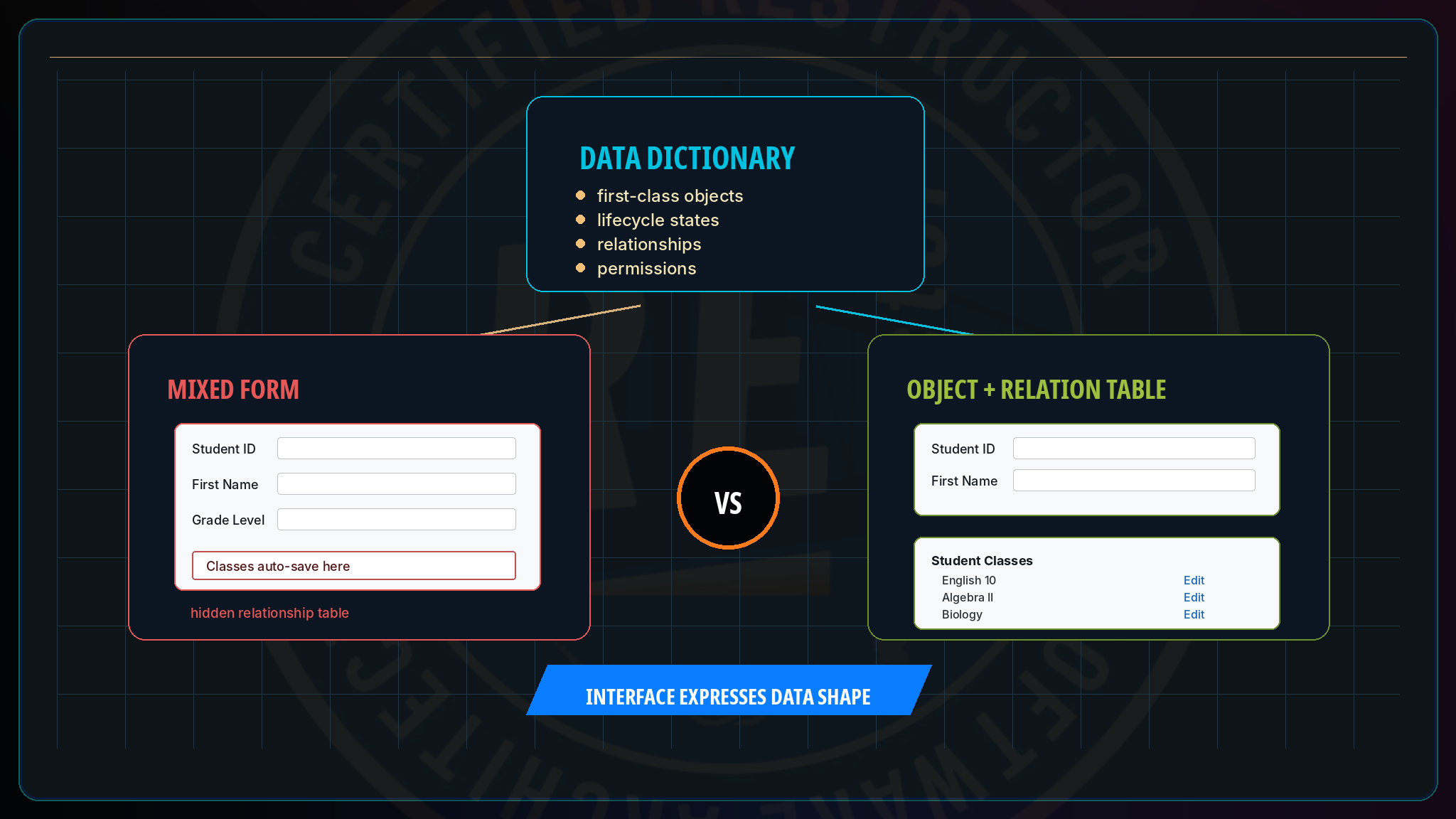
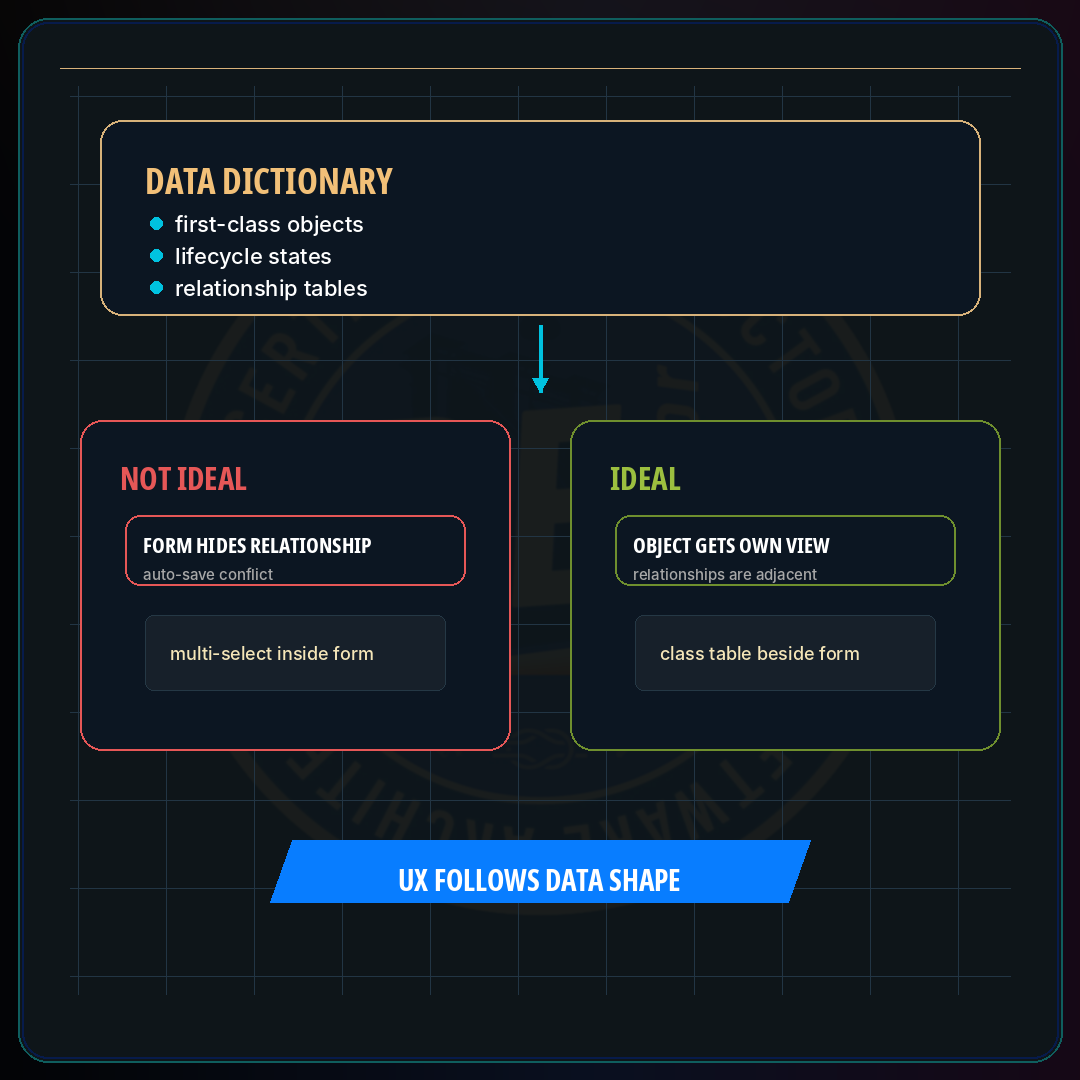
The places where B2B interfaces become unintuitive are almost always the places where the interface was designed against an imagined data model rather than the real one. A “simple” settings page collapses six different governed objects behind one Save button; a customer detail view conflates lookup tables with first-class records; a workflow screen exposes lifecycle states that were never named in the schema. Schema-first UX treats the data dictionary as the first design artifact: each first-class object earns a primary view, lifecycle states become explicit navigation, and many-to-many relationships move into adjacent list affordances rather than hiding inside parent forms. AI scaffolding amplifies the cost of getting this wrong, because generators happily produce slick interfaces against incoherent data shapes.
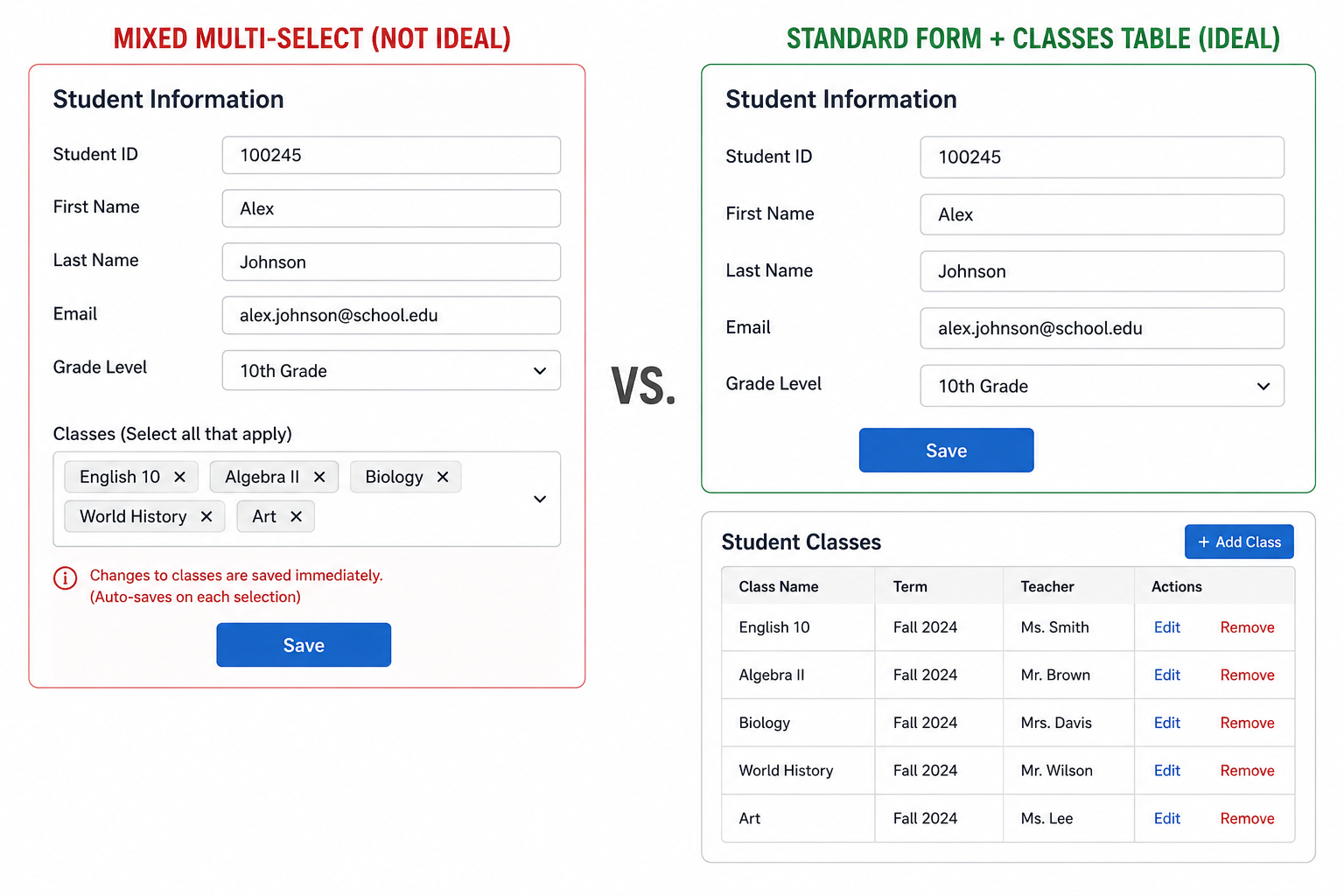
A concrete illustration of how schema-misalignment shows up at the form level: a form for a first-class object has a clear Save button, but a buried multi-select control quietly auto-saves on each selection because it’s actually updating a secondary many-to-many table. The user’s mental model is that nothing has been committed until they press Save; the system has been writing the whole time. This produces both user confusion about persisted state and brittle UI code maintaining two save paths in one form. The principled fix is not better wiring; it is to move the multi-select into its own list affordance, so the interface expresses the actual data shape rather than fighting it. Strong UX designers benefit more from data context than from CSS context, and that conversation belongs at the architecture layer rather than at the handoff to engineering.
© 2024–2026 Vitruvian Technology, Corp. All rights reserved. The Restruct Handbook and its contents are the copyrighted work of Vitruvian Technology, Corp. The handbook may be freely shared and distributed in its complete, unmodified form for educational and informational purposes, provided that all copyright and trademark notices are retained and Vitruvian Technology, Corp. (Vestive) is credited as the source. Excerpts and brief quotations may be used in articles, reviews, presentations, and other commentary with appropriate attribution. Modification, repackaging, or commercial redistribution requires prior written permission. Restruct™ and Certified Restructor™ are trademarks of Vitruvian Technology, Corp. Vestive® is a registered trademark of Vitruvian Technology, Corp. The Restruct™ methodology, the Certified Restructor™ program, and associated trademarks remain the exclusive property of Vitruvian Technology, Corp.