

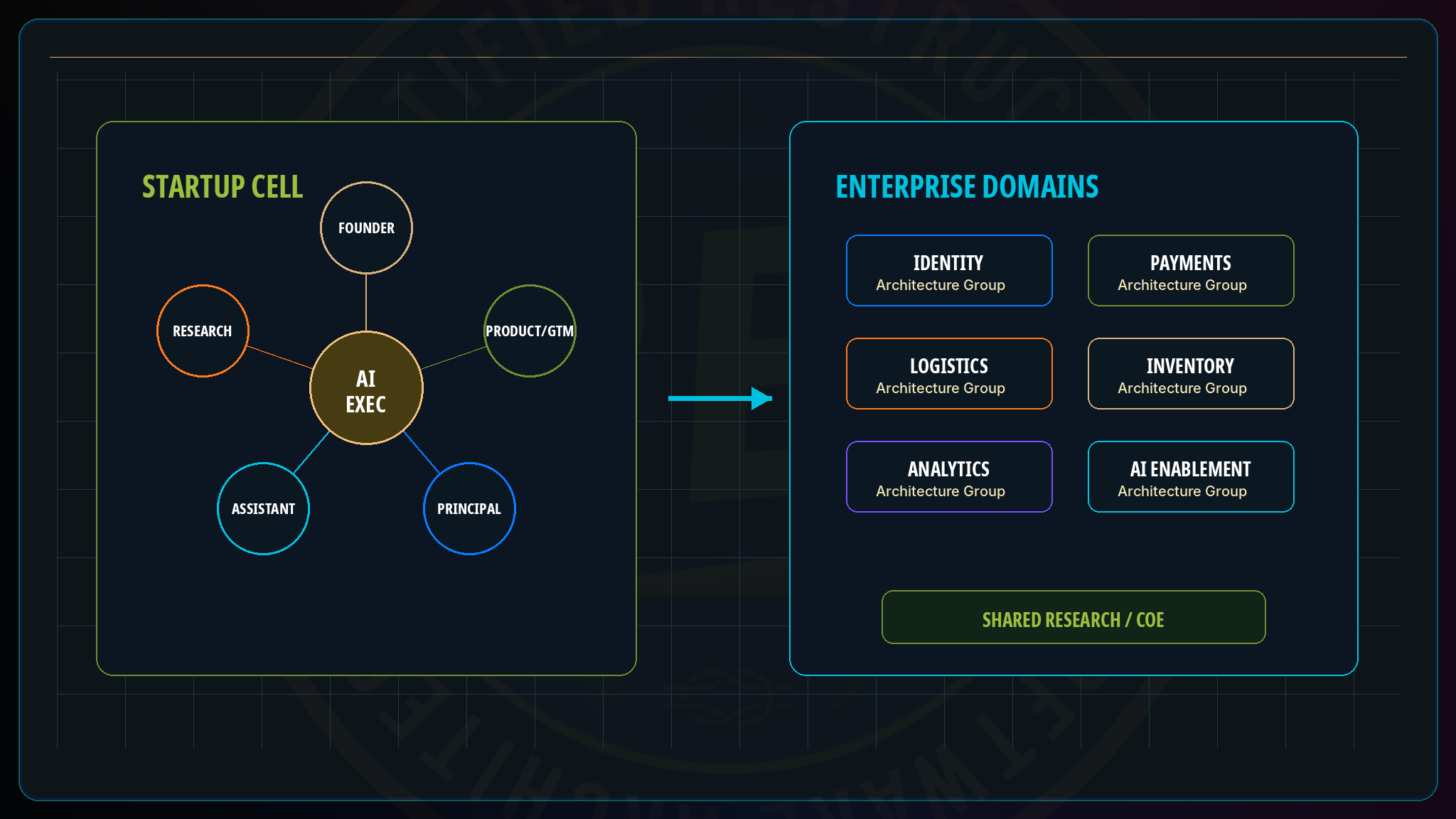
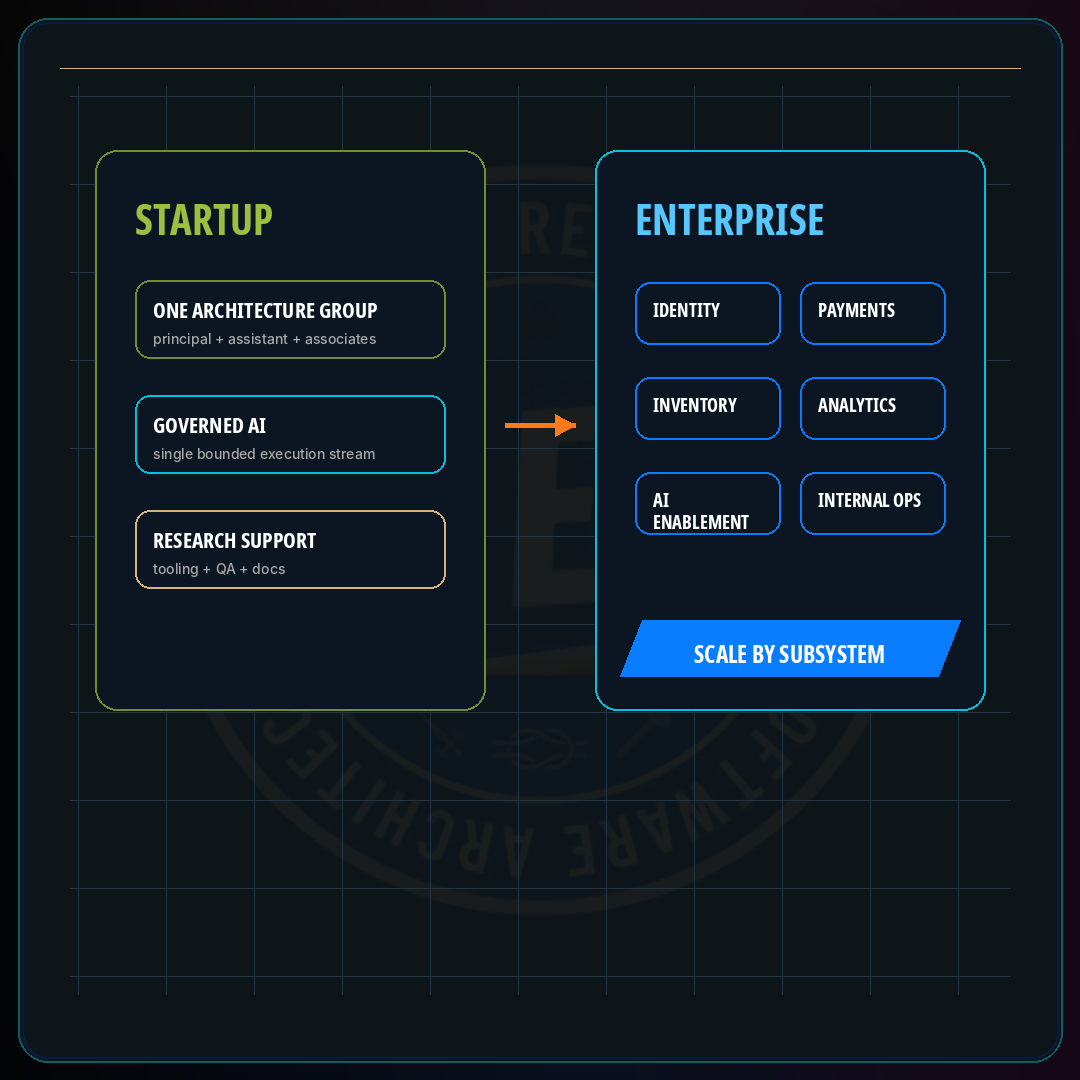
A common question is whether Restruct ™ only applies to large enterprises. The methodology scales progressively with organizational complexity rather than headcount — the same governance principles apply from a twenty-person startup to a two-thousand-person enterprise.
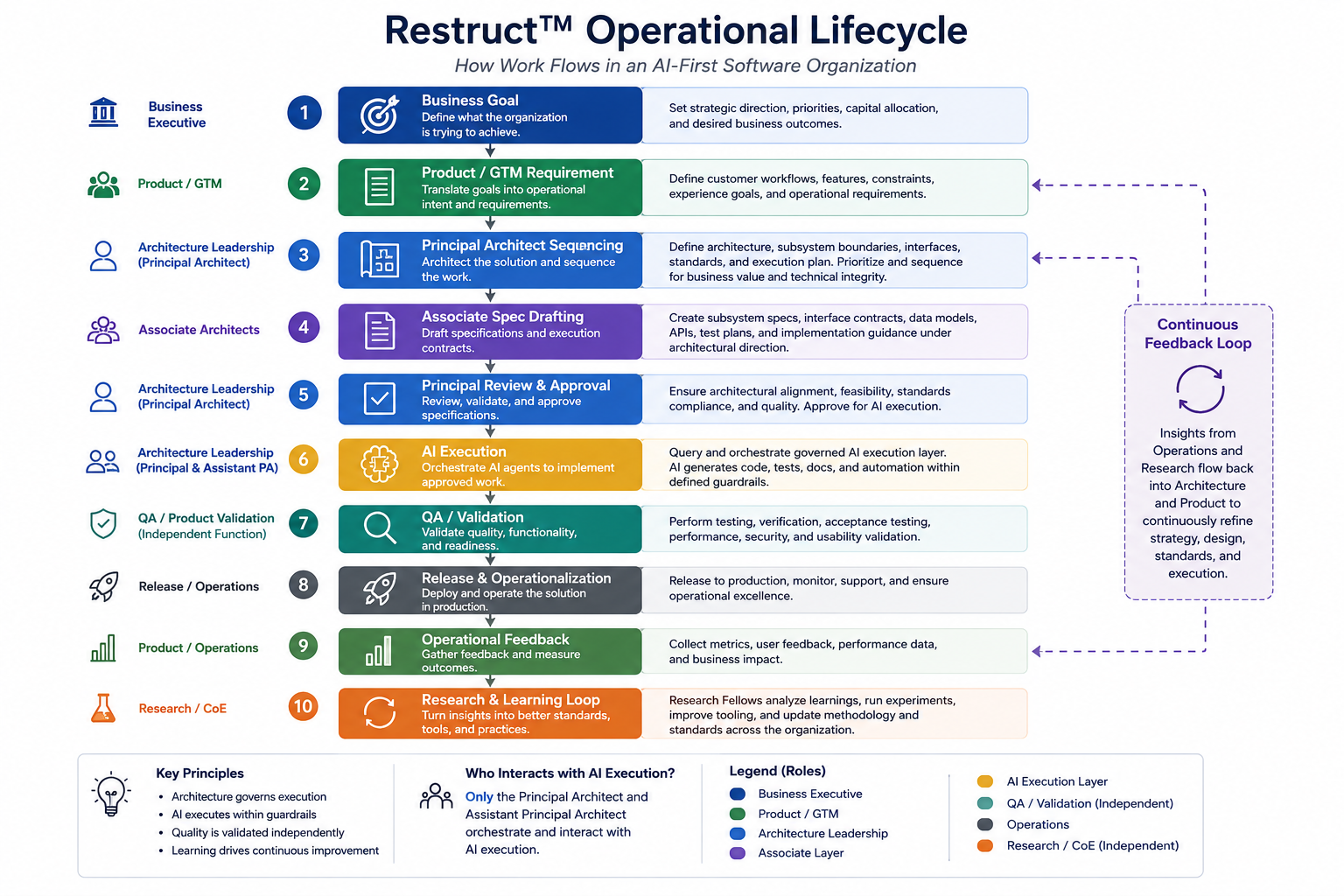
Consider a twenty-person B2B SaaS company building an AI-native operational platform. Under traditional models, it might structure itself around a CTO, engineering manager, frontend and backend engineers, DevOps, QA, product managers, designers, and generalized developers running Agile sprints — spending enormous time coordinating through standups, backlog refinement, sprint planning, dependency management, and unclear ownership.
Under Restruct ™ , the same organization operates more compactly: Founder / Business Executive, Product / GTM Lead, Principal Architect, Assistant Principal Architect, two Associate Architects, one or two Research Fellows, and governed AI execution infrastructure. The Principal Architect handles architecture, sequencing, AI orchestration, product translation, and subsystem governance directly. The Assistant Principal Architect supports execution review, QA governance, and architectural continuity. Associate Architects focus on specification drafting, workflow decomposition, operational contracts, and API planning. Research Fellows handle tooling experimentation, QA workflows, AI benchmarking, and documentation. AI systems handle implementation scaffolding, repetitive CRUD generation, testing, debugging, and refactoring.
Velocity emerges from architectural clarity, bounded ownership, governed execution, and compressed coordination overhead rather than implementation labor volume. As the product grows, architecture groups scale horizontally by subsystem complexity — one group governs billing, another AI orchestration, another internal operations, another customer workflows — each operating as a bounded cell governed through defined contracts and coordinated through peer Principal Architect relationships.
Example 2 — Enterprise Modernization Organization
Now consider a Fortune 500 modernization initiative. Traditionally: hundreds of engineers, multiple Agile release trains, project managers, scrum masters, architecture review boards, governance committees, fragmented vendor teams. Operational coordination becomes the primary workload — status reporting, dependency tracking, release coordination, planning ceremonies, cross-functional approvals.
Under Restruct ™ , the enterprise organizes around bounded architecture groups aligned to operational subsystems: customer identity, payments, logistics, inventory, analytics, AI enablement, internal operations. Each domain contains a Principal Architect, Assistant Principal Architect, Associate Architects, governed AI execution infrastructure, and embedded operational coordination. Research Fellows and Centers of Excellence operate horizontally across domains, supporting modernization tooling, AI governance, QA systems, benchmarking, and architecture standards.
Rather than massive centralized committees coordinating every implementation detail, architectural contracts govern subsystem interaction boundaries directly — reducing coordination ambiguity, dependency confusion, and organizational latency. AI execution lets these organizations modernize legacy systems faster than staffing-heavy models. The result resembles a distributed architecture institution coordinating governed operational systems at scale rather than a traditional software department.
These examples are intentionally simplified, but the pattern holds: as implementation commoditizes, organizational value shifts upward toward governance, architecture, sequencing, and institutional knowledge. Restruct ™ formalizes that transition explicitly rather than letting organizations drift into it accidentally.
© 2024–2026 Vitruvian Technology, Corp. All rights reserved. The Restruct Handbook and its contents are the copyrighted work of Vitruvian Technology, Corp. The handbook may be freely shared and distributed in its complete, unmodified form for educational and informational purposes, provided that all copyright and trademark notices are retained and Vitruvian Technology, Corp. (Vestive) is credited as the source. Excerpts and brief quotations may be used in articles, reviews, presentations, and other commentary with appropriate attribution. Modification, repackaging, or commercial redistribution requires prior written permission. Restruct™ and Certified Restructor™ are trademarks of Vitruvian Technology, Corp. Vestive® is a registered trademark of Vitruvian Technology, Corp. The Restruct™ methodology, the Certified Restructor™ program, and associated trademarks remain the exclusive property of Vitruvian Technology, Corp.