

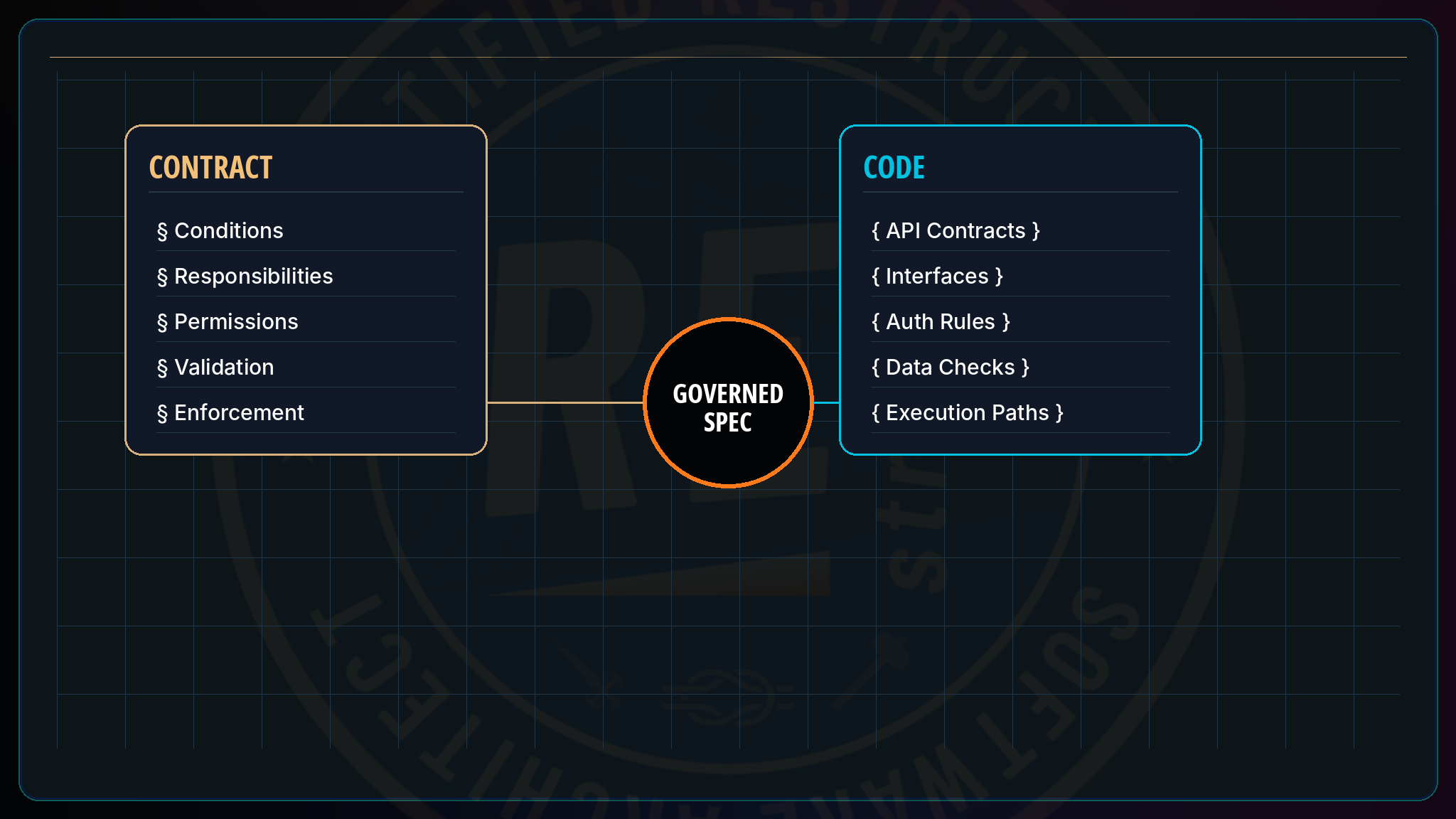
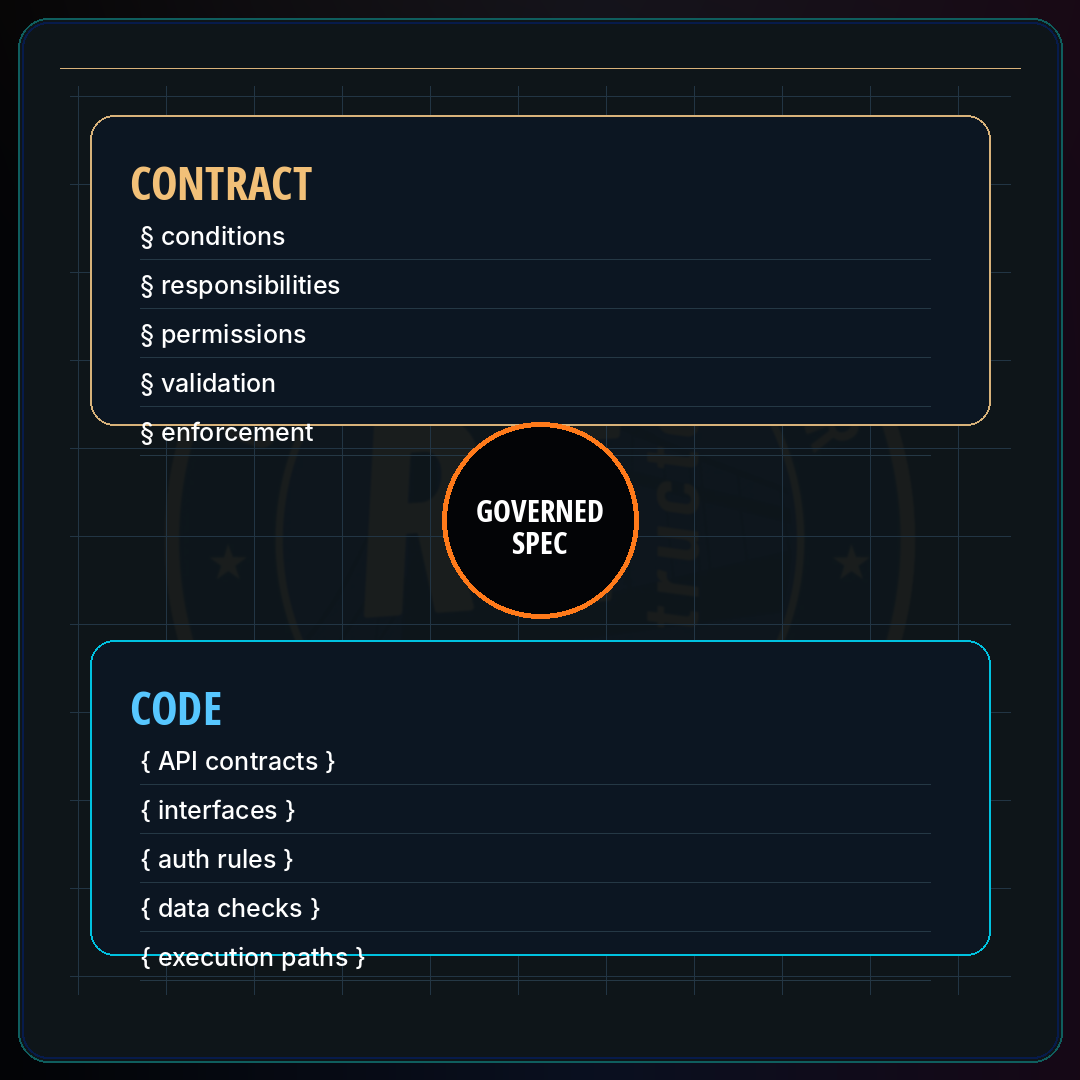
Engineers fear AI is coming for their jobs because they still mentally frame themselves as implementation labor. The industry spent decades telling them their value came from typing syntax. But software engineering increasingly behaves more like contract law than factory work.
A contract defines conditions, responsibilities, interfaces, permissions, liabilities, validation rules, escalation paths, and execution boundaries. Code does exactly the same thing. APIs behave like legal interfaces. Conditional logic behaves like clauses. Authentication is identity verification. Validation rules are contractual enforcement. Even the vocabulary overlaps: execution, interpretation, governance, specifications, permissions, enforcement.
Engineers historically implemented every operational detail manually because implementation was expensive and slow. AI changes that. Once AI can scaffold, refactor, test, debug, and operationalize, the human role shifts upward toward architectural intent, governance, sequencing, and liability management. That is not replacement — it is professionalization. Architects do not personally pour concrete. Lawyers do not personally enforce contracts. Mature industries separate specification from execution; software blurred them only because implementation itself was difficult. The real question is no longer whether AI replaces engineers, but whether engineers will evolve upward into architectural governance professionals.
There is a second reframe worth naming, and it situates AI inside a longer historical arc rather than treating it as a discontinuity. The transition that AI is accelerating was already underway long before frontier AI hit the mainstream, and this decade in particular has made it visible. There have been no materially new frontend frameworks worth the name — React is React and that is that. Salaries and contract rates peaked roughly a decade ago and have been quietly normalizing downward since. Serverless cloud providers are everywhere, and most production systems now involve more configuration with API keys than maintenance of self-hosted infrastructure. Software engineering as a discipline plateaued some years ago; the industry has been gradually maturing from a phase of constant reinvention into a phase of integration, configuration, and governance over established components.
The historical parallel is worth sitting with. IT as a profession went through a similar transition decades ago. Early IT workers wrote custom C drivers to make hardware work and built email and messaging systems from scratch for each enterprise. Today IT professionals configure mature equivalents — identity providers, mail platforms, operating systems, networking stacks — rather than writing them, because the underlying capabilities matured into infrastructure. Photographers traveled the same path: portraitists once traced likenesses by hand — painters projecting scenes with the camera obscura, operators cutting silhouettes on the physiognotrace — until the camera promoted them from manual “light-tracers” to arbiters of photo production.
The role did not disappear when that happened; it shifted upward into selection, integration, governance, and operational judgment. Web application engineering is on the same trajectory, and arguably has been for most of the past decade. AI did not cause this. AI accelerated a normalization that the industry had already been undergoing. The methodology Restruct ™ proposes — governance, specification discipline, architecture as a profession rather than a generalist label — is what professional maturity looks like on the other side of that transition.
© 2024–2026 Vitruvian Technology, Corp. All rights reserved. The Restruct Handbook and its contents are the copyrighted work of Vitruvian Technology, Corp. The handbook may be freely shared and distributed in its complete, unmodified form for educational and informational purposes, provided that all copyright and trademark notices are retained and Vitruvian Technology, Corp. (Vestive) is credited as the source. Excerpts and brief quotations may be used in articles, reviews, presentations, and other commentary with appropriate attribution. Modification, repackaging, or commercial redistribution requires prior written permission. Restruct™ and Certified Restructor™ are trademarks of Vitruvian Technology, Corp. Vestive® is a registered trademark of Vitruvian Technology, Corp. The Restruct™ methodology, the Certified Restructor™ program, and associated trademarks remain the exclusive property of Vitruvian Technology, Corp.