

The industry spent decades reacting against waterfall without understanding what it was reacting against. The issue was never phases — it was unmanaged dependency chaos.
Agile was invented in the 1990s, before the modern internet, before cloud deployment, in an era when shipping software meant burning CD-ROMs into boxes. That context mattered: deployment was slow, expensive, and risky, so shorter iteration loops made sense. Over time, Agile got ritualized into standups, sprint planning, backlog refinement, retrospectives, and planning poker — operational cultures formed around managing fragmentation instead of reducing it.
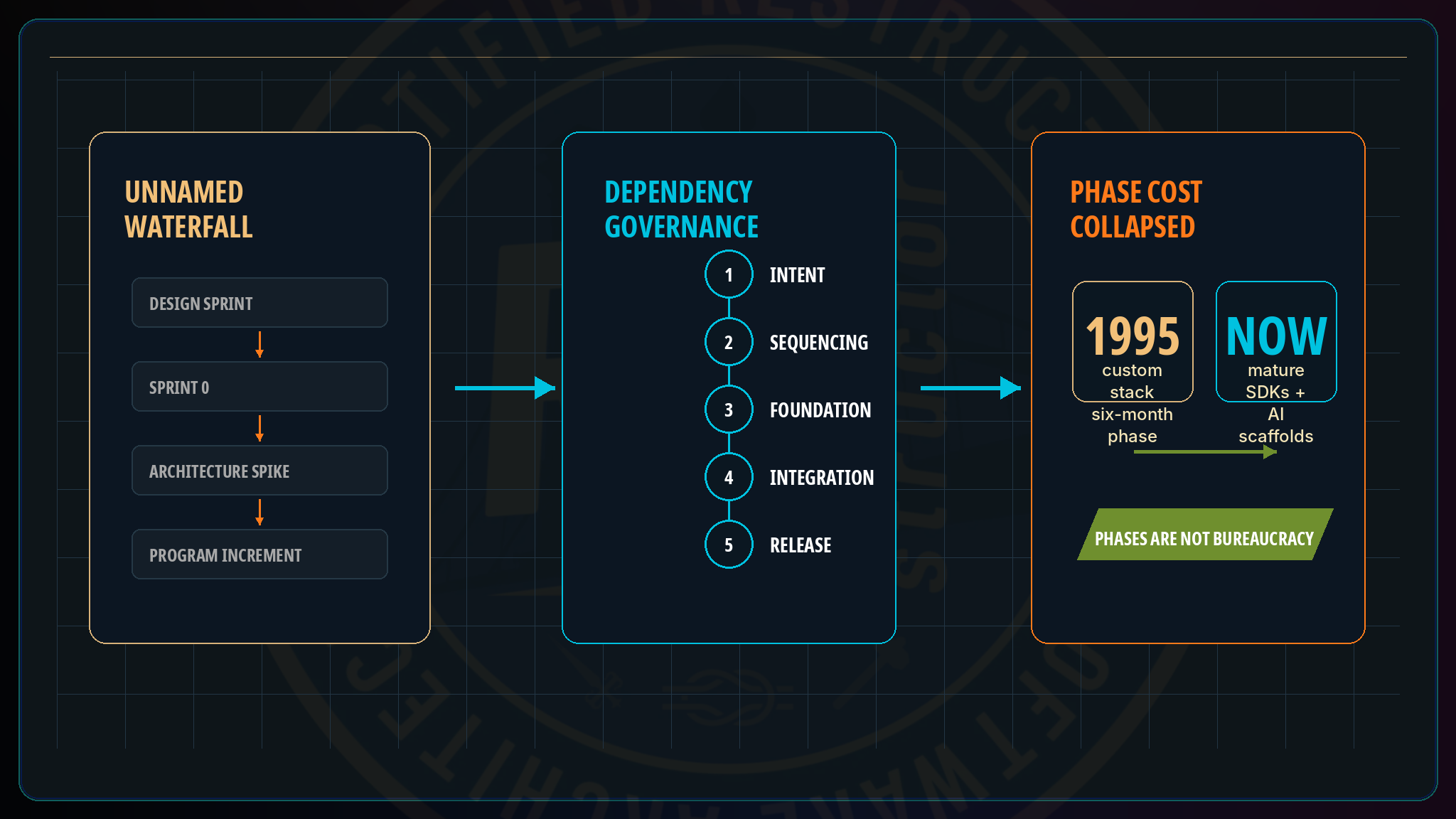
Ironically, modern Agile organizations still bury waterfall everywhere. Design sprints are waterfall. Sprint 0 is waterfall. Multi-sprint architecture spikes are waterfall. SAFe program increments are version planning in Agile clothing. Architecture spikes are sometimes delegated to juniors — the opposite of how every mature industry operates.
Restruct ™ calls a spade a spade. Complex systems have dependencies. Construction uses phases. Manufacturing uses sequencing. Architecture firms use governed approvals. Phases are not bureaucratic — they are dependency governance. AI actually increases the importance of architectural planning: when implementation approaches near-instant execution, bad architecture compounds faster too.
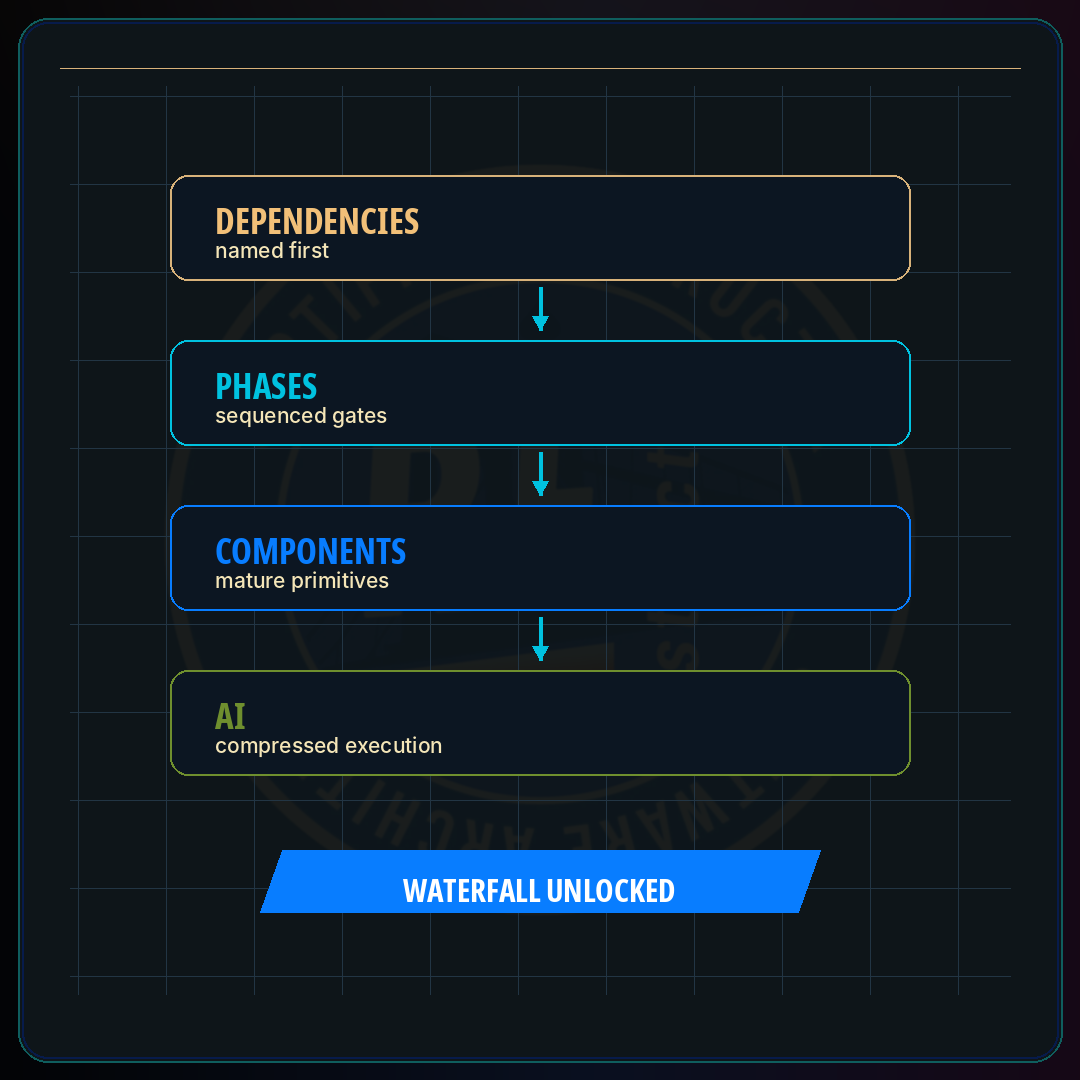
There is also a practical reason waterfall deserves to be embraced rather than apologized for: the cost of a phase has collapsed. In the 1990s, building or adding a meaningful subsystem could take six months because every layer was custom — the database, the auth, the queue, the deployment pipeline, the admin interface. Phases needed to be long because the work inside them was long. That world is gone. Today most subsystems are assembled from open-source primitives and off-the-shelf services: identity providers, payment platforms, queue systems, observability stacks, deployment platforms, vector databases, mature frameworks, and well-maintained SDKs. A subsystem that would have justified a half-year delivery in 1995 can take a sprint now. AI compresses it further. The components themselves have done much of the work the phase used to contain.
That changes what a phase actually costs. A phased, governed delivery model that would have been ruinously slow in the 1990s is now perfectly viable, and in many cases faster than the sprint-and-iterate approach that exists primarily to absorb the cost of getting things wrong. Waterfall is essentially unlocked. The industry should acknowledge that openly rather than continuing to bury phased delivery inside superfluous Agile semantics — design sprints, Sprint 0, architecture spikes, program increments — that pretend phases are something else. Naming the work honestly is the first step in governing it well.
© 2024–2026 Vitruvian Technology, Corp. All rights reserved. The Restruct Handbook and its contents are the copyrighted work of Vitruvian Technology, Corp. The handbook may be freely shared and distributed in its complete, unmodified form for educational and informational purposes, provided that all copyright and trademark notices are retained and Vitruvian Technology, Corp. (Vestive) is credited as the source. Excerpts and brief quotations may be used in articles, reviews, presentations, and other commentary with appropriate attribution. Modification, repackaging, or commercial redistribution requires prior written permission. Restruct™ and Certified Restructor™ are trademarks of Vitruvian Technology, Corp. Vestive® is a registered trademark of Vitruvian Technology, Corp. The Restruct™ methodology, the Certified Restructor™ program, and associated trademarks remain the exclusive property of Vitruvian Technology, Corp.